Running Google Ads requires more than targeting the right keywords. The structure of a landing page directly impacts conversion rate and campaign efficiency. Many marketers question: Should Google Ads landing page link to website landing page?
The answer depends on user intent, campaign goals, and how much information the audience needs before taking action. In most cases, high-performing landing pages function independently, guiding users toward a single conversion goal with minimal distractions.
This guide explains when linking supports performance, when it reduces effectiveness, and how to structure a landing page for better results.
In our experience managing Google Ads campaigns, landing page structure often has a bigger impact on performance than targeting itself. Many campaigns with strong traffic still underperform because the user journey is not controlled effectively.
What Is the Difference Between a Google Ads Landing Page and a Web Page?
Definition and Purpose
Understanding the difference between a Google Ads landing page and a website landing page requires examining both definitions and how they function in practice.
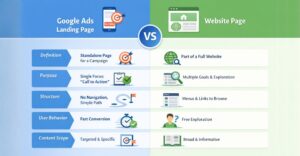
| Criteria | Landing Page (Google Ads) | Website Page |
| Definition | A standalone page designed for a specific campaign, where users land after clicking an ad or link | A page within a larger website that is part of a complete online presence |
| Purpose | Drive one specific action, such as form submission, booking, or purchase | Provide information and allow users to explore different parts of a business |
| Structure | Single page, highly focused, often with minimal navigation | Multiple interconnected pages with menus and navigation |
| User Behavior | Guided toward a clear conversion path | Free exploration across different sections |
| Content Scope | Highly targeted and campaign-specific | Broad, covering services, brand, and supporting content |
A Google Ads landing page focuses on a single objective and guides users to a single action. Every element is structured to support conversion.
A website page serves a broader role within a larger system. It provides information, navigation, and multiple pathways for users to explore based on their needs.
Read more: How Google Display Ads Grow Marketing Results in 2026
The difference between PPC and SEO is not just about traffic sources. It comes down to user intent and psychology at different stages of the funnel.
Google Ads Landing Page: PPC Intent
PPC (Google Ads) targets users who are typically at the bottom of the funnel. They are not browsing. They are actively looking for a solution, a price, or a provider to solve an immediate problem.
User psychology:
“I have a problem and I want to solve it now.”
In this context, a landing page acts as a conversion-focused environment. It removes unnecessary distractions and guides users toward one clear action. Success in PPC depends heavily on message match. The transition from the ad to the landing page must feel seamless. If the ad promotes a specific offer, the landing page needs to reflect that exact promise immediately.
When this alignment is missing, or when users are sent to a general website page, they are forced to navigate and evaluate too many options. This often leads to hesitation and drop-off.
In many campaigns we’ve managed, sending paid traffic to a full website instead of a focused landing page increases friction and reduces conversion rate, even when traffic quality is high.
Website Landing Page: SEO Intent
SEO (Organic Search) targets users who are often in the research or consideration stage. They are looking for information, comparisons, or guidance before making a decision.
User psychology:
“I want to understand my options before taking action.”
A website page, such as a blog or service page, is designed to support this behavior. It provides depth, context, and multiple pathways through internal linking, allowing users to explore and build trust over time. Unlike landing pages, SEO pages benefit from content depth and breadth. They aim to keep users engaged longer, encourage further exploration, and position the brand as a reliable source of information.
Pushing users into a conversion-focused landing page too early in this stage can feel aggressive. Instead of taking action, users are more likely to leave if they feel the page does not match their search intent.
👉 Simple rule:
PPC = action and conversion
SEO = research and evaluation
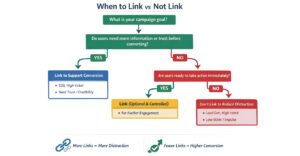
When Should You Link Your Google Ads Landing Page to Your Website?
Linking a Google Ads landing page to your website is useful for building trust and supporting user decisions, but it should only be done selectively.
In most cases, high-performing landing pages work best as standalone pages focused on a single conversion goal. Linking becomes effective when users need additional information or validation before taking action. The key is to use links only when they support the conversion journey, not distract from it.
High-Ticket or High-Consideration Services
High-value services require strong trust before users take action. Users often evaluate expertise, past results, and overall credibility.
A landing page presents key information such as testimonials and case studies. Some users want to explore further before making a decision. In this case, links to detailed case studies, portfolio pages, or company information provide additional confidence.
In high-ticket B2B campaigns, we often see users visit 2–4 pages before converting. If your landing page blocks that behavior entirely, conversion rate can drop even when traffic quality is high.
👉 Simple rule:
If users need trust before action, provide access to deeper information
Find out more: Why Do Advertisers Use Testimonials: How to Build B2B Trust and Convert
B2B or Long Sales Cycles
B2B users follow a longer decision-making process and often involve multiple stakeholders.
A landing page delivers the main message and drives the primary action. Additional links to service pages, resources, or company details support users who want to research more before moving forward.
👉 Simple rule:
If users need time to evaluate, support them with more resources.
When Users Need More Information
Some users require more context before they feel ready to convert.
A strong landing page already includes FAQs, service explanations, and clear value propositions. In situations where the information becomes too detailed for one page, links help users access more content without overwhelming the landing page.
👉 Simple rule:
If one page cannot cover everything, use links to expand information.
When Brand Credibility Needs to Be Reinforced
New or lesser-known brands rely on credibility to drive conversions.
A landing page builds trust through social proof, certifications, and clear positioning. Links to the main website, such as the About page or company profile, strengthen transparency and reinforce brand legitimacy.
👉 Simple rule:
If credibility drives the decision, provide clear proof and access to your brand story.
If you’re unsure how to balance trust and conversion in your campaigns, this is where a well-structured Paid Ads solution can make a measurable difference.
When Should You NOT Link Your Google Ads Landing Page to Your Website?
You should not link your Google Ads landing page to your website when your goal is to maximize conversions for a specific campaign, as additional links and navigation can distract users and reduce conversion rates.
In these cases, a landing page performs best when it focuses on a single call-to-action and removes all unnecessary exit paths. Keeping users on one clear journey increases the likelihood of conversion and improves overall campaign efficiency.
Lead Generation Campaigns
If your main goal is to collect leads, avoid linking users to other pages on your website.
A landing page works best when it focuses on one action only such as filling out a form or booking a consultation. Adding navigation links or redirecting users to your website creates distractions and reduces the chances of conversion.
In our audits, many campaigns underperform not because of targeting, but because users leave the landing page through navigation before completing the main action. Once those exits are removed or controlled, conversion rates often improve.
👉 Simple rule:
If you want users to submit a form → keep them on one page.
Find out more: 10 Best AI Lead Generation Softwares to Boost B2B Conversions in 2026
High-Intent Traffic
When users already know what they want (for example: searching “book dental appointment” or “get pricing now”), they don’t need to explore your website.
Sending them to multiple pages slows them down and may cause drop-off.
A focused landing page helps them take action immediately.
👉 Simple rule:
If users are ready to act → don’t make them browse.
Low-Ticket or Impulse Conversions
For offers that rely on quick decisions (discounts, limited deals, simple services), speed is everything. If users click away to your website, they may lose interest or overthink. A landing page keeps momentum and encourages fast conversions.
👉 Simple rule:
If it’s a quick decision → remove anything that slows users down
When You Need a Distraction-Free Conversion Flow
A full website usually has many elements: a menu, a blog, other services, etc. These create multiple paths and reduce focus. A landing page removes all unnecessary options and guides users step-by-step toward one goal.
👉 Simple rule:
The fewer choices users have → the higher the chance they convert.
Does Linking to Your Website Affect Google Ads Performance?
Yes — the way you link (or don’t link) your landing page to your website has a direct impact on performance, especially conversion rate and cost.
Impact on Conversion Rate
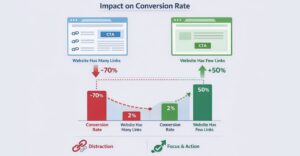
Linking to your website can either help or hurt your conversion rate, depending on how focused the user journey is.
Data from the Unbounce Conversion Benchmark Report shows that the median landing page conversion rate is 6.6%. In many industries, anything above 10% is already considered strong performance.
The key factor behind high conversion rates is focus.
- A landing page with one clear goal (e.g. submit form) → higher chance users convert
- A page with multiple links (menu, homepage, blog…) → users get distracted and leave without converting
Every extra click introduces a chance to lose attribution, especially when users move across multiple pages or devices before converting.
👉 Easy way to understand:
More links = more ways to leave
Fewer links = more chances to convert
Impact on Quality Score and CPC
Google doesn’t just look at your ads — it also evaluates your landing page.
Landing page experience is a key factor in Quality Score, which directly affects:
- Your ad ranking
- Your cost per click (CPC)
A strong landing page usually:
- Matches exactly what users searched for
- Provides clear and relevant information
- Loads fast and works well on mobile
When users stay longer and take action, Google sees this as a positive signal, which can help:
- Improve Quality Score
- Lower your CPC over time
👉 Important point:
A messy page with too many links can confuse users → lower engagement → worse performance → higher costs
Distraction vs Focused User Journey
Each additional link introduces another possible user path. A structured landing page creates a clear journey and supports faster decision-making. This approach increases the likelihood of users completing the intended action.
Best Practices for Google Ads Landing Pages
A high-performing landing page removes friction and guides users toward a single action.
Focus on a Single Conversion Goal
A strong landing page centers around one objective. All elements work together to support that action and create a consistent experience.
Minimize Navigation Links
Reducing navigation helps eliminate distractions and keeps users focused on the primary goal.
According to Unbounce, high-converting landing pages are designed to stand alone, meaning they remove traditional website navigation and limit unnecessary exit points. A focused experience ensures that users are guided toward a single action without competing choices.
However, this does not mean removing all supporting information. Instead of full navigation menus, marketers should use selective, conversion-focused elements such as:
- Testimonials
- Trust badges
- Short supporting sections (e.g., FAQs, key benefits)
These elements help build credibility within the same page, rather than sending users away to explore other parts of the website.
The key principle is not just limiting links, but eliminating anything that does not directly support conversion.
Landing pages or only a part of a comprehensive PPC strategy. If you want to maximize your campaign’s effectiveness, check out our full guide on how to create a PPC strategy that drives B2B growth.
Use Controlled Linking
Selective linking supports credibility and user validation.
Common examples include a homepage link through the logo or access to detailed case studies when needed. Each link serves a clear purpose within the conversion journey.
Optimize Page Speed and Experience
Page speed and usability play a critical role in performance.
A fast and smooth experience keeps users engaged and supports higher conversion rates across devices.
Choose the Right Strategy for Your Campaign
Landing page strategy depends on campaign goals and user intent.
Direct response campaigns benefit from simplicity and a focused structure. High-consideration campaigns benefit from additional supporting information within a controlled environment.
A balanced approach ensures both performance and credibility.
FAQs
Should I remove navigation from landing pages?
Removing navigation improves focus and supports higher conversion rates, especially in direct response campaigns.
Can I send Google Ads traffic to my homepage?
Dedicated landing pages aligned with ad intent deliver stronger performance and higher conversion rates.
How many links should a landing page have?
A focused landing page includes only links that support conversion or build trust. This approach maintains clarity and improves performance.
Conclusion
The decision to link a Google Ads landing page to a website depends on user intent and campaign goals. High-performing landing pages function as standalone experiences, present essential information clearly, and guide users toward a single action.
Selective linking supports credibility and enhances decision-making when additional information adds value. A structured and focused experience drives stronger performance and creates a more effective user journey.
A well-structured landing page does not mean removing all links. It means controlling where users go next and ensuring every path still supports conversion.