In 2026, Singapore’s digital landscape will have matured into one of the most sophisticated and competitive auctions globally. For businesses, Google Ads is no longer a “low-cost experiment” but a high-stakes strategic investment. With immense purchasing power and high advertiser density, the Singaporean market demands a precision-based approach to budgeting.
At Golden Owl Digital (GoDi), we’ve analysed internal performance data across over 50+ accounts in the local market to bring you this Google Ads cost in Singapore guide. Whether you are a growing SME or an enterprise, understanding the nuances of the 2026 CPC (Cost-Per-Click) benchmarks is the first step toward a profitable ROI.
Average Google Ads Costs in Singapore (2026 Benchmarks)
Google Ads operates on a real-time auction system. At a technical level, your actual CPC is determined by:
- Your bid
- Your Quality Score
- Competitor bids
- Overall auction competition
However, these auction variables do not exist in isolation. They are directly shaped by broader business and market factors — such as industry competition, keyword intent, geographic targeting, and seasonality — which we will break down in detail below.
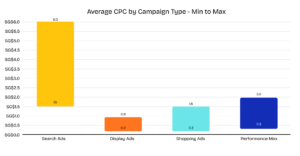
Average CPC by Campaign Type
The following CPC ranges reflect common industry benchmarks observed across Google Ads campaigns in Singapore. Actual CPC can vary depending on factors such as industry competition, keyword intent, audience targeting, and account optimisation.
Different campaign types show different cost patterns because they operate under different levels of auction competition and user intent.
| Campaign Type | Avg CPC (SGD) | Best For | GODi Expert Insight |
| Search Campaigns | $1.50 – $6.00 | High-intent lead generation | Highest intent, but requires strict match-type control. |
| Display Campaigns | $0.20 – $0.90 | Awareness & retargeting | Low cost, but watch out for “junk” placements. |
| Shopping Campaigns | $0.20 – $1.50 | E-commerce/ Retail | Highly visual; cost varies by product price point. |
| Performance Max Campaigns | $0.30 – $2.00 | Multi-channel automation | Uses AI to find the cheapest conversion path. |
While Search campaigns lead in conversion intent, they also carry the highest CPC in Singapore’s 2026 auction. Golden Owl Digital’s internal data shows that the ‘efficiency gap’ between Search and Display only closes when a multi-touch attribution model is used.
We advise clients not to view CPC in isolation but through the ‘Efficiency Index’: a balanced review of conversion rate stability versus acquisition costs. This ensures that a ‘cheap’ click doesn’t lead to an expensive dead-end.
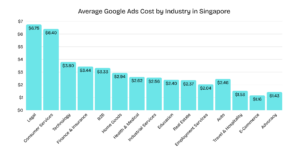
Average Google Ads Cost by Industry in Singapore
In high-stakes sectors, a single lead can translate into five or six-figure revenue. Consequently, Google ads costs for industries such as fintech are the most aggressive.
| Industry | Avg Search CPC (SGD) |
| Legal | $6.75 |
| Consumer Services | $6.40 |
| Technology | $3.80 |
| Finance & Insurance | $3.44 |
| B2B | $3.33 |
| Home Goods | $2.94 |
| Health & Medical | $2.62 |
| Industrial Services | $2.56 |
| Education | $2.40 |
| Real Estate | $2.37 |
| Employment Services | $2.04 |
| Auto | $2.46 |
| Travel & Hospitality | $1.53 |
| E-Commerce | $1.16 |
| Advocacy | $1.43 |
Typical Monthly Budget by Business Size
Instead of asking “What is the minimum budget?”, a better question is: “How much budget is required to generate meaningful results?”. This is also how we usually approach paid ads campaigns at Golden Owl Digital.
The table below helps you have a clearer grasp of the average monthly google ads cost based on industry benchmarks:
| Business Type | Typical Monthly Ad Spend |
| Startup / Micro SME | 1,000 – 3,000 |
| Growing SME | 3,000 – 7,000 |
| Competitive SME / Mid-size | 7,000 – 10,000 |
| Enterprise | 10,000+ |
Important Note
Smaller budgets can work — but they limit:
- Data collection speed
- Optimisation learning
- Conversion testing
- Scaling opportunities
Below SGD $1,000, campaigns often struggle to gather enough conversion data for optimisation.
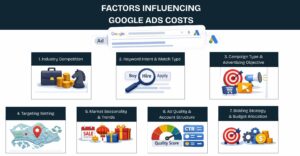
What Factors Influence Google Ads Costs?
Understanding cost drivers helps businesses manage spending more effectively.
1. Industry Competition
Industries with higher customer lifetime value usually experience higher CPC in Singapore.
Singapore is a compact and mature market. Many advertisers compete for the same high-intent keywords. In sectors such as finance, legal services, and B2B consulting, a single customer can generate significant long-term revenue. Because of this, businesses are willing to bid more aggressively to secure qualified leads.
Based on our managed accounts, industries with recurring revenue or contract-based services consistently show higher baseline CPC. This is not necessarily a sign of inefficiency. It often reflects stronger revenue potential per client.
When evaluating cost, the key question is not whether CPC is high, but whether acquisition cost is sustainable relative to profit margins.
2. Keyword Intent & Match Type
High-intent keywords cost more because they are closer to conversion.
Search queries such as “apply SME business loan Singapore” or “hire audit firm Singapore” clearly indicate purchase search intent. Advertisers recognise this value and compete more aggressively for these terms. As a result, transactional keywords typically have significantly higher CPC than informational searches within the same industry.
From our internal campaign data, the CPC difference between informational and transactional keywords can be two to three times, even under similar market conditions.
Match type strategy determines how efficiently the intent is captured. Broad match increases reach but requires strong negative keyword control to avoid wasted spend. Phrase match provides a balance between scale and relevance. Exact match allows tighter control for high-value search terms.
The primary cost driver is not the keyword volume itself, but how closely the keyword reflects immediate buying intent.
3. Campaign Type & Advertising Objective
Different campaign types produce different cost structures because they capture users at different stages of intent.
Search campaigns usually have a higher CPC because they target users who are actively searching for a solution. These campaigns are commonly used for lead generation and direct response objectives.
Display campaigns typically have lower CPC. However, they target broader audiences and are more suitable for awareness and retargeting rather than immediate conversions.
Shopping and Performance Max campaigns often show moderate CPC levels. Their cost efficiency depends heavily on product competitiveness, feed quality, and historical conversion data.
Cost also varies depending on the objective you optimise for. Lead generation campaigns focus on cost per lead. E-commerce campaigns prioritise return on ad spend. Awareness campaigns are evaluated using CPM and reach metrics.
The key principle is alignment. When the campaign type matches the business objective, cost efficiency improves. When there is misalignment, CPC may remain reasonable but the acquisition cost can become unstable.
4. Targeting Setting
Targeting decisions have a direct impact on both CPC and lead quality.
Location targeting is often one of the biggest cost drivers in Singapore. Running campaigns that target only Singapore typically results in higher CPC compared to regional Southeast Asia campaigns. This is due to stronger purchasing power and higher advertiser competition within the local market.
Within Singapore, the targeting strategy should align closely with the business model. For example, service-based businesses that rely on physical delivery or in-person visits should avoid broad nationwide targeting. Narrowing location targeting to specific districts or proximity-based areas often reduces wasted clicks and improves conversion quality, even if CPC increases slightly.
Audience targeting also influences cost efficiency. B2B campaigns usually perform better during office hours, while consumer-focused campaigns may see stronger engagement in the evening. Aligning ad delivery with user behaviour helps improve conversion rate rather than simply lowering CPC.
Device targeting plays a similar role. In some industries, desktop traffic converts at a higher rate despite a higher CPC. In others, mobile generates volume but requires stronger landing page optimisation to remain profitable.
More precise targeting does not always reduce CPC. However, it often lowers cost per acquisition by filtering out low-intent traffic and focusing spend on users more likely to convert.
5. Market Seasonality & Trends
CPC often increases during major seasonal peaks in Singapore.
Common high-demand periods include:
- Chinese New Year
- National Day promotional periods
- Q4 festive campaigns
- School enrollment seasons
- Financial year-end cycles
During these periods, competition intensifies as more advertisers increase budgets to capture demand. As a result, average CPC rises across many industries.
For example, e-commerce campaigns typically see CPC increase significantly in Q4 due to festive shopping demand. In the education sector, CPC often rises before major enrollment periods as schools and enrichment centres compete aggressively for parents’ attention.
Experienced advertisers do not pause campaigns during peak seasons. Instead, they adjust budgets strategically, refine targeting, and optimise conversion funnels to maximise return during high-intent periods.
6. Ad Quality & Account Structure
Google calculates Ad Rank using: Ad Rank = Bid × Quality Score
Quality Score is influenced by:
- Expected click-through rate
- Ad relevance
- Landing page experience
Well-structured accounts with tightly grouped keywords tend to achieve:
- Higher CTR
- More stable CPC
- Better conversion rates
In many audits, poorly organised campaigns show a noticeable portion of spend going to irrelevant queries.
7. Bidding Strategy & Budget Allocation
Automated bidding strategies such as Target CPA and Maximize Conversions require stable data input.
Frequent budget changes or constant bid manipulation can reset learning phases and increase inefficiency.
Cost efficiency improves when:
- Budget allocation is stable
- Data tracking is accurate
- Optimisation decisions are data-driven
How Much Does Google Ads Management Cost in Singapore?
Beyond media spend, management expertise plays a significant role in cost control.
Common pricing structures include:
- Flat monthly retainers
- Percentage of ad spend (10%–20%)
- Hybrid performance models
Typical ranges:
- Freelancers: SGD 500 – 1,000
- Boutique agencies: SGD 800 – 2,000
- Performance-focused agencies: Higher retainers or percentage-based models
The real evaluation metric should be: “Does management reduce wasted spend and improve ROI?”
An experienced team often offsets their fee by eliminating inefficient traffic and improving conversion rate.
How Golden Owl Digital Optimizes Your Google Ads Budget
At Golden Owl Digital, budget planning begins with revenue goals.
Data-Driven Budget Planning
We reverse-calculate from revenue targets:
- Required leads
- Lead-to-close rate
- Average deal value
- Estimated CPC
This allows realistic budget forecasting before campaigns launch.
Conversion-Focused Campaign Structure
Campaigns are structured by search intent clusters, controlled match types, and precise audience segmentation. This improves Quality Score, stabilises CPA, and reduces wasted spend.
Cost Reduction Without Sacrificing Performance
Optimisation includes:
- Ongoing search term audits
- Negative keyword expansion
- Bid strategy refinement
- Landing page CRO improvements
- Device and time-of-day adjustments
In our PPC strategy, the focus is on long-term stability and scalable performance.
FAQs About Google Ads Costs in Singapore
What is a good CPC in Singapore in 2026?
For Search campaigns, SGD 1.50–6.00 is common. High-value industries may exceed this range.
Is SGD 1,000 per month enough?
For small-scale testing, yes. For competitive lead generation, most businesses require 2,000–5,000 SGD monthly for meaningful results.
Why is Singapore more expensive than other Southeast Asian countries?
Higher purchasing power, stronger competition, and more mature digital adoption increase auction pressure.
What industries have the highest CPC?
Legal, finance, insurance, and B2B services typically pay the highest CPC.
What is a good cost per lead for B2B?
Depending on industry and deal size, many B2B campaigns range from SGD 80 to SGD 250+ per lead.
Should SMEs manage Google Ads in-house?
If internal expertise is limited, agencies can accelerate optimisation and reduce costly learning mistakes.
Conclusion
Google Ads costs in Singapore vary significantly depending on industry competition, keyword intent, campaign structure, and optimisation strategy. Rather than focusing purely on cost per click, businesses should evaluate advertising investment based on revenue potential, cost per acquisition, and long-term scalability.
When campaigns are strategically structured, data-driven, and continuously optimised, Google Ads can become one of the most predictable and profitable growth channels in Singapore’s competitive market.
If your company is currently evaluating budget requirements or would like a personalised cost forecast based on your industry and revenue goals, contact us to receive a free 1:1 consultation and tailored cost assessment.