
In 2026, more than 77% of patients start their healthcare journey with a Google, Bing or Yahoo search. At the same time, Google has tightened its rules for medical websites through Your Money or Your Life (YMYL) standards, AI-generated search results, and stronger trust signals.
Hence, clinics that don’t show up online, or don’t look credible when they do, get skipped. You can run a solid clinic with experienced doctors and modern facilities, but without visibility, foot traffic and revenue stall. Patients can’t come to a clinic they don’t know exists.
That is why SEO for healthcare matters in 2026. SEO determines whether patients can find your clinic, understand what you treat, trust your expertise, and book an appointment without friction.
This guide by Golden Owl Digital breaks down how to do SEO for healthcare in a way that matches how patients actually search today and how search engines now evaluate medical providers.

Why is SEO Important for Healthcare Providers?
Patients today choose a clinic in a fairly consistent pattern: They search first, often on their phone, usually with a specific concern in mind, and they decide quickly based on what shows up and how credible it feels.
For healthcare providers, SEO is about being present, visible, and trusted at the exact moment someone needs care.
Here is why it matters in practice:
- Increases online visibility:
SEO helps you show up for searches that reflect different patient needs, from someone comparing providers to someone looking for urgent care options. Keyword targeting allows you to align content with intent. A well-managed Google Business Profile and strong performance on “near me” or time-sensitive searches directly affect foot traffic and bookings. - Builds trust and credibility:
Consistent visibility at the top of search results signals legitimacy, experience, and reliability, especially in healthcare where trust is non-negotiable. When your pages clearly explain conditions, treatments, and next steps, you reduce uncertainty before a patient ever speaks to your team. - Creates long-term, cost-effective patient acquisition:
Paid ads can drive short-term volume, but they stop the moment budgets pause. SEO compounds. Strong organic rankings continue to attract qualified patients without paying for every click.
SEO Strategy Guide for Healthcare Providers in 2026
In healthcare SEO, almost everything revolves around E-E-A-T (Experience, Expertise, Authoritativeness, and Trustworthiness). These are the signals Google uses to evaluate medical websites and they should always be kept in mind.
That’s why credibility and usability are the backbone of any medical website. This includes aligning with local healthcare privacy regulations, whether that’s HIPAA (US) or equivalent frameworks.
It also means regularly validating site structure, content accuracy, and technical compliance through a healthcare-focused SEO audit.
Below is how you can achieve this.
Build A Trustworthy and User-friendly Healthcare Website
This usually includes foundational priorities such as:
1. Mobile-first design
Urgent searches rarely happen on desktop, which is why you must optimize your healthcare website for mobile through:
- Finger-friendly UI: Make sure buttons (like “Call Now” or “Book Appointment”) are at least 44×44 pixels so they can be tapped easily without zooming.
- The “Thumb Zone”: Place critical navigation items and CTA buttons near a user’s thumb.
- Avoiding pesky interstitials like pop-ups blocking the main content. Google penalizes mobile sites that make content hard to access.
2. Fast load speed
This is particularly important for service and condition pages. Your website should always load under 3 seconds.
To do this, you can:
- Compress images using WebP format
- Prioritize loading the top section by using “Lazy Loading” for images further down.
- Check your LCP (Largest Contentful Paint), which measures the load time for the main content. Aim for below 2.5 seconds
3. Clear navigation
This usually includes:
- Flat site architecture: Service and condition pages are within 3 clicks at most from the homepage
- Easy language: Avoid jargon like “Cardiology Services”. Instead, use “Heart Care.”
- Breadcrumbs: Help users know where they are (e.g., Home > Services > Pediatrics > Immunizations) and provide Google with clear internal linking structures.
- Security through Technical SEO
Security and compliance form the technical foundation of healthcare SEO.
At minimum, clinics should ensure:
- HTTPS and reliable hosting
- Structured data for medical organizations, doctors, and locations
The CMS also needs to support frequent updates. Doctor availability, services, and locations change regularly, and SEO efforts slow down quickly when every update requires development support. That’s why we tend to perform a technical SEO audit to define underlying problems like this.
Optimize The Homepage of Your Healthcare Website
A healthcare homepage is a trust filter, a navigation hub, and a conversion trigger, all evaluated under YMYL standards. Below is our checklist of must-have sections for every healthcare homepage.
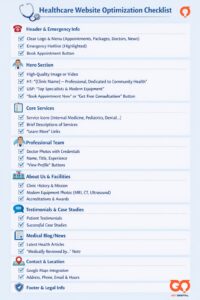
1. Header (Navigation & Emergency Access)
This is where users look for help first, especially on mobile.
- Logo: Clear, professional, and always linked back to the homepage.
- Navigation menu: Structured and easy to understand, with clear service categories (e.g. Services, Health Packages, Doctors, News).
- Emergency / Consultation hotline:
Must be visually prominent (often red or orange) and implemented as click-to-call, especially for mobile users. - Primary booking CTA:
A visible “Book Appointment” button placed in the top-right area. - SEO & UX tip:
Include a search bar with keyword suggestions to help users find services, conditions, or doctors quickly, improving engagement signals.
2. Hero Section (First Impression & Relevance Signal)
This section determines whether users stay or leave within seconds.
- Main heading (H1):
Crucial. Must include the primary keyword and clearly state who you are and what you offer.
Example: “[Clinic Name] – Trusted Healthcare Services for Your Family” - Visual assets:
High-quality images or videos showing real doctors, facilities, or patient interactions. Avoid stock imagery that looks generic. - USP / Trust signals:
Clearly highlight differentiators such as international certifications, years of experience, or medical standards (e.g., JCI, ISO, 20+ years of practice). - Primary CTA:
Action-oriented and patient-friendly, such as “Book an Appointment” or “Get Free Consultation”.
An example of a hero section is the one from Mayo Clinic Hospital

3. Core Services Section (Topical & Internal Linking Foundation)
This section helps Google understand what the clinic actually provides and guides users to the right care path.
- Service list:
Display core services using proper heading hierarchy (H2 / H3), icons or images for each specialty (e.g., Internal Medicine, Pediatrics, Dental Care). - Short descriptions:
1–2 concise sentences explaining benefits, written in patient-friendly language and including relevant secondary keywords. - Deep links to service pages:
Every service must link to its dedicated page. These links act as the SEO backbone, passing link equity from the homepage to deeper pages.
4. Professional Team Section (E-E-A-T & Trust Validation)
Doctor visibility is a critical trust signal in healthcare SEO, which can be obtained through:
- Doctor portraits:
Professional photos in medical attire to reinforce credibility. - Essential information:
Full name, medical title (MD, MSc, Specialist II, etc.), years of experience, and previous affiliations if relevant. - Detail page links:
Each doctor must have a “View Profile” link leading to their individual profile page (internal linking is mandatory). - Structured data:
Implement Person or Physician schema so search engines can recognize doctors as real, qualified medical entities.
Create Patient-Centric and Medically Reviewed Healthcare Content
A patient-centric structure organizes content around how people think about care:
- Services, which describe what the clinic offers
- Conditions, which reflect what patients experience
- Treatments, which explain how the clinic helps
From there, you should create a clear services hub, supported by one dedicated page per service with a clear URL such as /services/physical-therapy
Content usually works best when divided into two main pillars:
- Condition blogs describe what patients experience
- Treatment blogs explain how the clinic helps.
These pages should be extensively interlinked with doctors and locations to reinforce topical relevance.
This structure benefits both patients and search engines, because it makes relationships between symptoms, services, providers, and locations explicit and easy to understand.
Medical accuracy also matters for healthcare content. Publishing false medical information can have serious long-term consequences on performance.
Healthy content usually includes:
- FAQs
- Condition explainers
- Treatment and “what to do” guides
- Language that is patient-friendly rather than overly clinical
All medical content should be written or reviewed by qualified professionals, factually accurate, and updated regularly. It should also cite authoritative sources when relevant (e.g., NIH, CDC)

Target Symptom-Based and Long-Tail Healthcare Keywords
Most patients don’t search using clinical language.
They describe symptoms, discomfort, and uncertainty in plain terms, such as “chronic knee pain” or “can’t sleep because of back pain.” Local intent is often layered in, especially for specialist and urgent care searches.
High-performing healthcare keywords often include:
- Symptom-based phrases (e.g. “chest pain after exercise”, “persistent lower back pain”)
- Problem-oriented searches (e.g. “when to see a cardiologist”, “treatment for knee arthritis”)
- Local intent modifiers (e.g. “urgent care near me”, “pediatrician in [city]”)
Pages that perform well tend to
- Address symptoms directly
- Explain potential treatment paths without making guarantees
- Guide patients toward appropriate next steps
Service keywords still play a role, but symptom-based searches often convert earlier because they align with patient intent at the decision stage.
Optimize Google Business Profile
For many clinics, Google Business Profile drives more bookings than the website itself.
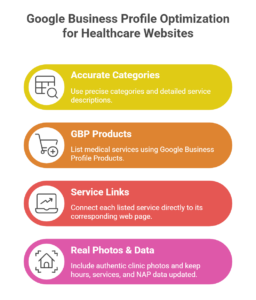
An optimized profile typically includes:
- Accurate categories and service descriptions
- Medical services listed using GBP Products
- Direct links from each listed service to its matching service page
- Real clinic photos and updated hours, services, and NAP (Name, Address and Phone number) data
Local SEO tends to perform best within a realistic radius, typically around five miles, rather than trying to rank broadly. Early on, it is also more effective to concentrate reviews on a primary clinic profile instead of distributing them across individual physicians.
We usually assist when clinics are unsure which local signals actually move bookings, and which ones simply create noise across profiles and locations.
Reinforce Trust With Credentials, Awards, and Patient Proof
Physician credentials, certifications, affiliations, and relevant awards should be easy to find on doctor profiles, service pages, and key landing pages. These signals help patients quickly understand who they are dealing with and why the clinic is qualified to provide care and advice.
Patient reviews and testimonials reinforce that trust. Highlight a small number of relevant reviews that reflect care quality and service experience, and surface them on the homepage, service pages, and booking paths. When handled correctly, reviews support credibility, strengthen local SEO signals, and reduce friction at the point of conversion.
Develop Doctor Profile Pages to Demonstrate E-E-A-T
Doctor profiles play a central role in healthcare SEO because they support E-E-A-T, a framework Google uses to evaluate whether content comes from real, qualified, and trustworthy professionals.
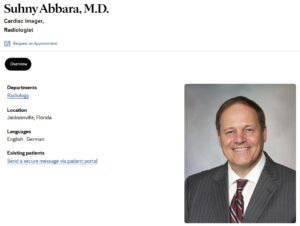
Each physician should have a dedicated page that includes:
- Credentials and specialties
- Conditions and treatments they focus on
- Clinic locations where they practice
- Human elements such as bios and photos
The doctor profile page from Mayo Clinic Hospital is a good representation:
Quoting doctors within medical content and linking those quotes back to their profiles strengthens E-E-A-T signals.
Appointment booking options should be visible directly from physician pages.
Build Healthcare Authority Through Compliant Backlinks and Citations
Authority in healthcare is built gradually.
High-quality backlinks typically come from
- Reputable healthcare websites
- Medical associations
- Local health organizations.
At the same time, consistent NAP information across medical directories and local listings remains a baseline requirement.
Low-quality or irrelevant link-building tactics tend to damage credibility and should be avoided entirely.
Optimize Appointment Booking
Booking should never feel complicated.
Effective booking systems usually offer:
- Click-to-call buttons
- Plain text phone numbers
- Contact forms
- Online scheduling
- Map directions
Booking CTAs should appear across service pages, condition pages, doctor profiles, and location pages. Accessibility and clarity across age groups directly affect conversion rates. That’s why you must reduce as much friction as possible, since patients should never have to “figure out” how to book
Appointment conversion paths should also be tested end-to-end before traffic growth becomes a priority, because more visitors only magnify existing friction. This can often be uncovered through a focused SEO audit.

Manage Reviews and Patient Trust
To have a safe review process, you should:
- Actively collect patient reviews on your Google Business Profile, especially after completed appointments or procedures, using neutral, non-incentivized requests.
- Centralize review management so responses are handled by trained staff, not individual doctors or front-desk employees responding ad hoc.
- Establish a formal review response SOP that clearly defines what is allowed and what is not.
Responses should remain neutral, appreciative, and non-specific to protect patient privacy. Acknowledge the feedback, thank the reviewer, and invite offline communication through general contact channels when appropriate.
Measure Performance and Continuously Optimize
Teams should track local rankings, page-level performance for services and conditions, and conversion metrics such as calls and bookings. Regular reviews should also account for content accuracy, staffing changes, and Google algorithm updates related to YMYL topics.
Performance tracking usually focuses on:
- Local rankings
- Service, condition, and symptom page performance
- Calls, form submissions, and bookings
Regular reviews should account for
- Content accuracy
- Staffing and service changes
- Algorithm updates related to Your Money Your Life (YMYL) topics.
Many analytics tools may conflict with data protection laws, so prioritize first-party analytics to monitor without unnecessary risk.
Advanced Healthcare SEO Tips for 2026
AI-generated search results increasingly surface clear, concise definitions of medical terms. Pages that explain conditions and treatments in straightforward language are more likely to appear in AI overviews.
Voice search continues to grow, particularly for urgent care queries that include location and time modifiers. Clear local signals and structured data help capture this demand.
Video content also plays a growing role. Short “Meet the Doctor” videos or treatment overview clips often appear in search carousels and reinforce trust during early decision stages.
This is usually where our SEO service at Golden Owl Digital comes in, helping healthcare teams connect technical SEO, content structure, and local signals into one coherent setup.
Common Mistakes in Healthcare SEO
The mistakes we see most at Golden Owl Digital often include:
- Publishing content that unintentionally reveals patient identity or medical records
- Scaling content and keywords before fixing site trust, speed, and booking flow.
- Collapsing services, conditions, and locations into generic pages that dilute relevance.
- Focusing on clinical terms while ignoring symptom-based and local search intent.
- Publishing medical content without visible physician authorship or review processes.
- Treating doctor profile pages as secondary instead of core trust assets.
- Splitting Google Business Profiles and reviews too early, weakening local visibility.
- Managing reviews without clear privacy-compliant response guidelines.
- Using analytics tools without considering healthcare compliance risks.
- Letting doctor, service, and location changes go unmaintained over time.
Conclusion
SEO for healthcare in 2026 requires a focus on trust, clarity, and operational consistency.
Healthcare providers that invest in solid structure, patient-centric content, and compliant processes tend to see steady gains over time. Those gains compound when SEO is treated as infrastructure rather than a short-term growth tactic.
Our role is often to help teams diagnose where effort is leaking and where small structural changes can unlock long-term growth. When healthcare SEO is built thoughtfully, it supports both patient care and sustainable business outcomes.
FAQs About Healthcare SEO
Should you outsource healthcare SEO or keep it in-house?
Many providers keep medical review in-house while outsourcing strategy, technical SEO, and local optimization. The right balance depends on internal expertise and compliance comfort.
How long does healthcare SEO take to show results?
Initial improvements often appear within three to six months, with stronger compounding effects over time when fundamentals are solid.
Is healthcare SEO more expensive than other industries?
Costs can be higher due to compliance and review requirements, but patient lifetime value often justifies the investment.
Can small clinics compete with large hospital networks?
Local clinics can compete effectively through strong reviews, clear positioning, and patient-focused content.
Does healthcare SEO work without paid ads?
SEO can perform independently, although paid ads can support early growth or seasonal demand.