

Setting SEO goals sounds simple – until you try to connect rankings to real business results. In 2026, realistic SEO goals are no longer about vanity metrics. They’re about growth you can measure, explain, and repeat.
At Golden Owl Digital, we see businesses struggle with translating SEO efforts into measurable business outcomes all the time. The key to success isn’t just chasing rankings; it’s aligning SEO objectives directly with business goals like revenue or qualified lead generation.
This guide walks you through a practical, step-by-step way to set SEO goals that actually make sense, using real numbers, real tools, and real examples from modern digital teams. This framework shows how to actually set a realistic SEO goal using data instead of assumptions.
Key takeaways:
|
What Is a Realistic SEO Goal & Why It Matters in 2026
Before we dive into the data-heavy methodology, let’s clear the air on what a “realistic” SEO goal actually is. It’s not about wishful thinking. A realistic SEO goal is a target that sits at the intersection of:
- What your business needs
- What your website can achieve
- What the market will allow
A realistic SEO goal is a quantifiable, time-bound metric that directly contributes to a measurable business outcome, vetted against your current resources, market competition, and historical performance.

Realistic SEO goals aligned with business outcomes and growth strategy
Many teams still confuse SEO goals with wishes.
“We want to rank #1.” “We want more traffic.” “We want to beat competitors.”
These are desires, not goals.
A realistic SEO goal answers four questions clearly:
- How much growth? (traffic, leads, revenue)
- From where? (which pages, keywords, funnels)
- By when? (clear timeframes)
- Why does it matter to the business?
Why Setting Realistic Goals Is Your First Strategic Move
Search has changed.
- AI Overviews reduce organic CTR
- SERPs are more competitive
- Content volume is exploding
That means overestimating SEO results is riskier than ever.
Realistic goals:
- Protect budget decisions
- Align SEO with revenue teams
- Build trust with stakeholders
Think of it like advertising psychology.
Just like marketers ask “Why do advertisers use testimonials?”—because social proof builds trust – SEO goals also need credibility. If the numbers don’t feel believable, nobody buys in.
Step-by-Step: How to Set a Realistic SEO Goal
Setting an effective SEO goal is less about inspiration and more about following a precise, data-driven workflow. This six-step process ensures your goals are both ambitious and grounded in reality.
Step 1: Align with Business Objectives

Aligning SEO goals with business revenue and customer acquisition objectives
SEO does not exist in a vacuum.
Before touching keywords or tools, answer this: What does the business actually need from SEO?
At Golden Owl Digital, we help teams focus on the revenue impact of SEO by translating business goals into clear, data-driven targets. Whether your goal is to reduce paid ad reliance, increase qualified leads, or improve customer acquisition, the key is to tie SEO actions to measurable business outcomes right from the start. This focus ensures that every SEO effort is intentional and relevant to the larger business strategy.
Common answers:
- Increase demo bookings
- Reduce paid ads dependency
- Grow ARR from organic traffic
- Enter a new market
Let’s assume the business objective is to gain $3 million in new ARR.
- Current Sales Data: Historically, organic search contributes 20% of qualified leads (MQLs).
- Conversion Rates: Your sales team closes 5% of MQLs, and the average annual contract value (AOV) is $20,000.
- SEO’s Contribution:
- Target New ARR from SEO: 20% of $3M = $600,000.
- Number of New Customers Needed: $600,000 / $20,000 AOV = 30 New Customers.
- Number of MQLs Needed: 30 New Customers / 5% CVR = 600 MQLs.
Your Aligned Business Goal: To drive 600 new Marketing Qualified Leads (MQLs) from organic search within the next 12 months.
Notice how this goal isn’t “rank for 100 keywords”. It’s a precise, financially significant target that your SEO efforts must deliver.
This step alone filters out unrealistic expectations.
Step 2: Audit Current Performance
You can’t plot a map to a new location without knowing your starting point.
This step involves a deep, forensic analysis of your existing SEO health, primarily using Google Analytics (GA4) and Google Search Console (GSC). Below is a practical SEO audit framework using GA4, GSC, and Ahrefs to benchmark realistic goal setting.
| Tool | Metric | Significance | Benchmark/Analysis |
| GSC | Current Position & CTR | Reveals quick wins (keywords ranking 11-20) and poor title/meta descriptions. | Identify keywords ranking on Page 2 and calculate potential traffic gain if they move to Page 1 (e.g., Position 8). |
| GA4 | Organic Conversion Rate | Shows the quality of your existing traffic. If CVR is 0.5%, a traffic-doubling goal is less effective than a CVR improvement goal. | Compare your organic CVR to industry benchmarks (e.g., 2.3% is typical for B2B; 1-2% for e-commerce). |
| GSC/Ahrefs | Technical Health | Crawl errors, Core Web Vitals (CWV) scores, mobile-friendliness. | A poor CWV score (e.g., LCP > 2.5 seconds) suggests a technical ceiling that must be fixed before setting ambitious content goals. |
| Ahrefs/Semrush | Link Profile | The number and quality of referring domains (RDs) vs. top competitors. | If your RD count is 50 and your top competitor has 500, any goal requiring high-difficulty keyword rankings is immediately unrealistic. |
These numbers define your starting line.
Setting a goal without this is like running without knowing the distance.
For instance, if you have 50 blog posts that get high impressions but a low Click-Through Rate (CTR) of 1.5% in GSC, an easy goal is: “Increase CTR to 3.5% for the top 50 impression-generating pages by optimizing titles and meta descriptions within the next quarter.”
This is a traffic goal achieved without writing any new content.
Step 3: Research & Validate Opportunity
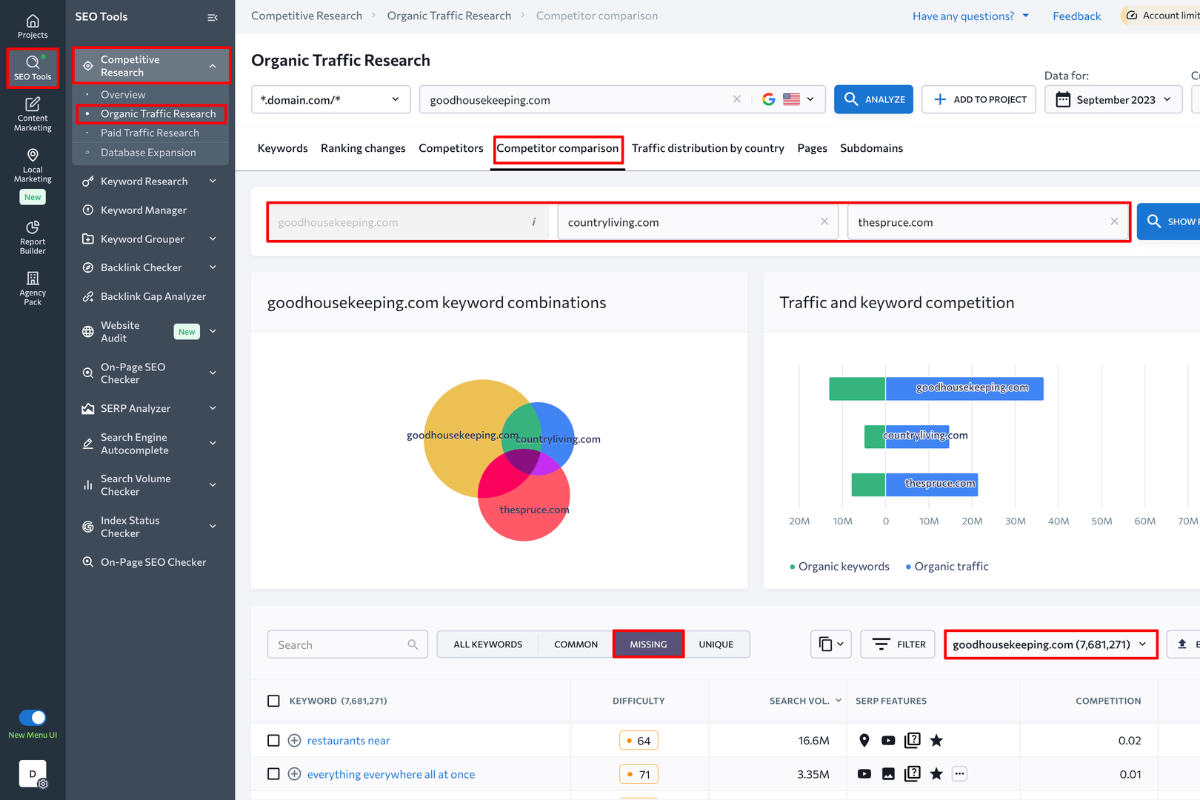
Keyword research and competition analysis to validate realistic SEO opportunities
Now you look outward.
- Keyword Volume and Intent Mapping
Use tools like Semrush, Ahrefs, or Moz to analyze the total search volume of your target keyword cluster. The key is to map keywords by intent:
- Informational (Top-of-Funnel): “What is digital transformation?”
- Commercial Investigation (Middle-of-Funnel): “digital transformation agency vs in-house team.”
- Transactional (Bottom-of-Funnel): “digital transformation consultant pricing.”
A Realistic SEO goal always focuses on the commercial and transactional intent keywords because those drive revenue.
- Competitor SERP Analysis
Examine the Search Engine Results Pages (SERPs) for your target commercial keywords. Look for two things:
- Domain Authority (DA) Gap: If your DA is 30 and the entire first page is occupied by sites with DA 80+, your goal of ranking in 6 months is likely unrealistic.
- Content Gap: Are the top-ranking pages thin? Is their content outdated? An opportunity exists if you can create a 10x better resource.
- The Opportunity Calculation
This is where you move from subjective assessment to hard numbers:
| Potential Traffic = (Total Search Volume) × (Estimated CTR for Target Position) × (Share of Voice) |
- If the total monthly volume for your target cluster is 10,000 searches.
- If you realistically aim for position 3 (Estimated CTR: 8.5%).
- If your competitors already own 40% of the top 10 positions (Share of Voice: 60% remaining).
Calculation: 10,000 volume × 8.5% CTR = 850 Estimated Monthly Clicks.
If the 850 clicks are primarily on high-intent keywords, this becomes the input for your final SMART goal in Step 4.
Just like testimonial ads work best when they feel specific and relatable, SEO keywords convert better when they match real user intent.
This is another reason why advertisers use testimonials—specific stories outperform vague claims. SEO works the same way.
Step 4: Craft SMART SEO Goals
This is where realism becomes math.
The SMART framework is mandatory for realistic goals. A goal must be: Specific, Measurable, Achievable, Relevant, and Time-bound.

SMART SEO goal formula using traffic, CTR, conversion rate, and average order value
This is what we use to turn SEO into a predictable, repeatable growth model. Our approach to SMART SEO goals is rooted in using historical performance data, such as current traffic, conversion rates, and value per conversion, to project future results. By grounding SEO targets in real numbers, businesses can set expectations that align with both short-term results and long-term growth.
The most sophisticated SEO goals don’t stop at traffic; they use a mathematical formula to tie organic traffic directly to revenue, often called the SEO Revenue Forecasting Model.
Use this simple formula:
| Revenue = Traffic × CTR × CVR × AOV |
Example calculation
- Target keywords impressions: 300,000/month
- Expected CTR: 3%
- Expected CVR: 2%
- AOV: $1,500
Result:
- Traffic: 9,000 visits
- Conversions: 180
- Revenue: $270,000
Now ask:
- Are these CTR and CVR realistic based on history?
- Can SEO influence this within 6–12 months?
If not, adjust.
Step 5: Set Time Frames & Milestones
SEO does not move in a straight line.
Break goals into phases:
| Time Frame | Focus Area | Action Examples | Expected Result |
| 0-3 Months (Short-Term) | Technical & Quick Wins | Fix Core Web Vitals issues, implement structured data, optimize titles/meta descriptions for pages 1.5 – 2.0 (GSC). | 15-20% Increase in Organic Impressions and 10% Improvement in overall Organic CTR. |
| 3-6 Months (Mid-Term) | Content & Internal Linking | Publish 5 high-authority pillar pages, update 15 existing high-potential articles, build internal links from high-authority pages to target pages. | Initial Page 1 Rankings for 5-10 mid-tail keywords, 25% Increase in MQLs from optimized articles. |
| 6-12 Months (Long-Term) | Authority & Revenue | Dedicated link-building campaign (e.g., digital PR), consolidating content, tackling high-difficulty commercial keywords. | Achievement of the SMART Goal: e.g., reaching the target of 850 Clicks/Month and the projected $252,000 in ARR. |
Example milestone:
- Month 3: +15% non-branded impressions
- Month 6: +25% organic traffic
- Month 12: +40% organic revenue
Milestones keep stakeholders patient—and confident.
Step 6: Track, Measure & Refine
Forget vanity metrics. Your goal is not a fixed monument; it’s a living document.
You must constantly track performance against your milestones and be ready to refine your strategy.

Tracking SEO KPIs such as traffic, conversions, and revenue over time
Track KPIs that connect to business value:
- Organic traffic (non-branded)
- Conversion rate
- Revenue per visit (RPV)
- Assisted conversions
If something underperforms:
- Improve content intent match
- Optimize CTR (titles, meta)
- Strengthen internal linking
SEO goals are not set once.
They evolve.
Example of a Realistic SMART SEO Goal (Business-Aligned)
A smart SEO goal works best when it starts with a clear business objective and then translates that objective into measurable SEO actions. Instead of guessing what SEO might deliver, this approach shows exactly how SEO contributes to revenue.

SMART SEO goal connected to revenue and business objectives
Company context
- Business type: B2B SaaS company
- Core objective: Increase monthly recurring revenue (MRR) by $50,000 within 12 months
- Average customer value: $2,500 per year
- Target customers needed: 20 new customers per month
SEO’s role in the growth plan: The company decides SEO should contribute 40% of new customer acquisition.
That means SEO needs to deliver:
- 8 new customers per month
- Equivalent revenue impact: ~$20,000/month
Current SEO performance (baseline)
- Organic sessions: 30,000/month
- Conversion rate (trial or demo signup): 1%
- Lead-to-customer rate: 20%
Current customers from SEO: 30,000 × 1% × 20% = 60 customers/month
Growth opportunity from SEO
Based on keyword research and content expansion, the team estimates:
- +15,000 additional non-branded organic sessions/month
- Improved conversion rate from 1% → 1.2% through better intent targeting and UX
Projected SEO impact: 45,000 sessions × 1.2% × 20% = 108 customers/month
Incremental gain from SEO:
- +48 customers/month
- Well above the required 8 customers/month target
SMART SEO goal statement: Increase non-branded organic traffic by 15,000 monthly sessions and improve organic conversion rate from 1% to 1.2% within 9 months, generating at least 8 additional customers per month and contributing approximately $20,000 in monthly recurring revenue.
Common Mistakes That Make SEO Goals Unrealistic (and How to Avoid Them)
Setting SEO goals often fails not because the strategy is wrong, but because expectations are unrealistic from the beginning. Many teams chase impressive numbers without grounding them in data, resources, or business context.

Common mistakes teams make when setting unrealistic SEO goals
Below are the most common mistakes to avoid if you want SEO goals that actually deliver results.
- Focusing on traffic instead of business outcomes: Setting goals like “increase organic traffic by 50%” without tying them to leads or revenue often results in high traffic with low value. Traffic should always be a supporting metric, not the end goal.
- Ignoring current baseline performance: Goals that don’t consider existing traffic, conversion rates, or growth trends are usually disconnected from reality. If your site has been growing at 5–8% monthly, expecting a 100% jump in one quarter is rarely realistic.
- Copying competitor metrics without context: Using competitor traffic or rankings as direct targets ignores differences in domain age, backlinks, brand strength, and historical SEO investment. Competitors are benchmarks—not templates.
- Underestimating SEO timelines: Expecting meaningful SEO results in a few weeks is a common mistake. In most industries, SEO requires 3–6 months to show traction and 6–12 months to generate consistent ROI.
- Setting goals without matching resources: Ambitious SEO goals often fail when content production, technical support, or link-building capacity is limited. Goals must align with what your team and budget can realistically execute.
- Obsessing over single “money” keywords: Ranking #1 for one keyword rarely drives sustainable growth. Modern SEO success comes from owning topic clusters and groups of keywords with shared intent.
- Failing to revisit and refine goals over time: SEO is affected by algorithm updates, SERP changes, and market shifts. Goals that aren’t reviewed and adjusted regularly become outdated and misleading.
Conclusion
Realistic SEO goals are not conservative – they’re strategic. When goals are grounded in data, aligned with business needs, and reviewed regularly, SEO becomes predictable growth, not a guessing game. Once you understand how to actually set a realistic SEO goal, SEO stops being a guessing game and becomes a growth system.
At Golden Owl Digital, we help teams set SEO goals that stakeholders trust and revenue teams respect. If you’re tired of vague promises and want SEO targets that actually convert, we’re here to help.